“One of the very nicest things about life is the way we must regularly stop whatever it is we are doing and devote our attention to eating.” Luciano Pavarotti
Welcome to Day #3 of Refrigerator Confidential! This week, you are up close and personal with our refrigerator. You can see what we buy at the Saturday Upcountry Farmers Market, and how we prepare it during the week. It’s kind of a game for us {a very tasty game I might add}, and the goal is to eat all or most of the food by Friday, and end up with lots of empty bags to fill up at the market on Saturday. Sometimes we are successful, and sometimes we don’t do so well. The refrigerator’s Friday appearance has to do with how many times we eat out during the week {restaurants, beach BBQs, etc.}, as well as how motivated we are to take the time to wash the greens, broccoli, etc. and cook them. Sometimes it’s easier to throw a salad together, with the already washed lettuce, than to wash and steam the broccoli; I think you know what I mean.
Monday’s Meals:
Breakfast
Me- The little bit of chili and brown rice that was leftover from yesterday
My husband- Nancy’s Low-fat Plain Yogurt with local honey, dried Maui pineapple, dried Maui apple bananas & coconut flakes, roasted peanuts & walnuts
Freshly Pressed Ginger Kombucha {1 bottle is almost gone already!}
Green tea
Lunch
Gerald’s Eggs with Red Peppers & Parmesan {these eggs are a kind of open-face omelette/frittata that Gerald made up~really good}
Baked potato with butter {we shared a potato}
Caesar Salad
Avocado
Dinner
I worked tonight, so we didn’t eat the same thing. We usually do, but it did’t work out this time because there was only 1 piece of Chicken Cacciatore left…for me!
Me- Chicken Cacciatore, broccoli & 1/2 grapefruit {and a piece of chocolate~ Lindt Dark Chocolate with Black Currants!!!}
My husband- sandwich on Dave’s Killer Bread {sometimes we will break down & buy a loaf of bread, if we run out of homemade bread…we like Dave’s} with Gruyere cheese, lots of arugula and mayonnaise {he said it was really good}, broccoli
Welcome to Day #2 of Refrigerator Confidential! This week, I’m taking you inside our refrigerator so you can see what we buy at the Saturday Upcountry Farmers Market, and what we do with it throughout the week. It’s kind of a game for us {a very tasty game I might add}, and the goal is to eat all or most of the food by Friday, and end up with lots of empty bags to fill up at the market on Saturday. Sometimes we are successful, and sometimes we don’t do so well.
Yesterday I told you in words and pictures what we bought at the market. I didn’t say anything about what else was in the refrigerator. We had {not an exhaustive list, by any means}:
leftover homemade chili
leftover brown rice
cooked broccoli
homemade mustard vinaigrette
beets, which I cooked and pickled yesterday
Sunday’s Meals with links to recipes:
Breakfast Me- Nancy’s Low-fat Plain Yogurt with olive oil, salt, pepper, cumin; broccoli with a drizzle of mustard vinaigrette
My husband- Nancy’s Low-fat Plain Yogurt with local honey, dried Maui pineapple, dried Maui apple bananas & coconut flakes, roasted peanuts & walnuts
Freshly Pressed Ginger Kombucha {1 bottle is almost half gone already!}
Green tea
Lunch
Leftover chili & brown rice {they’re almost gone!}
Salad of kale, arugula, pickled beets, Maui onion, Wakame & Ginger Sauerkraut Salad with mustard vinaigrette
Broccoli with olive oil, lemon, salt, pepper, Parmesan and toasted sliced almonds
Dinner Baked salmon with mayonnaise and Sweet Ginger Chili sauce {similar to Thai sweet chili sauce, but with healthier ingredients} Caesar salad with homemade croutons and avocado
Pickled Beets
4 fresh beets, scrubbed and steamed until tender {about 45 minutes for medium size beets}
Onion, sliced {as much as you like, or none}
3/4 cup cider vinegar
1/4 cup sugar
1/4 tsp kosher salt
1/4 tsp whole peppercorns
2 small bay leaves {or 1 large}
When beets are tender when pierced with a knife, let them cool until you can handle them comfortably. Peel off the skins, and cut them into whatever shape you like. Put them into a container with a tight lid, so you can turn them upside down to distribute the pickling liquid. If you are using onions, layer them in with the beets. I usually use a quart mason jar. In a small saucepan, combine all ingredients and bring them to the boil, stirring to ensure that the sugar gets dissolved. Pour over beets and onions. There will not be enough liquid to cover your beets, so turn the container upside down occasionally, and shake to distribute the liquid. They will get tastier as they marinate longer.
“You probably don’t want to look in the crisper drawer.” Amanda Freitag Chef and owner of Empire Diner
Welcome to my refrigerator! I must admit right from the start that I “tidied up” a bit before I let you in. I’m pretty sure that you would probably do the same, if you were planning to invite me in. My husband and I cook many/most of our meals together, but I am the Curator of the Refrigerator. I know what goes in, and its approximate location. The biggest haul that goes into the refrigerator comes from the Saturday farmers market, and I find a home for all of it-no easy feat to be sure. My husband goes to the market very early on Saturday mornings, while I go for a nice long walk, during which time I listen to the Splendid Table podcast on my phone. If you haven’t heard the Splendid Table, I highly recommend that you check it out here. Anyway, back to our refrigerator. This week, I would like to show you what our refrigerator looks like, from its early Saturday morning sparseness to bulging at the seams later Saturday morning, then during the week as we eat our way through all the delicious fruits and vegetables, which come mostly from the Upcountry Farmers Market.
I should say that the way we eat requires time and effort…time and effort that we are willing to put into procuring, preparing and eating delicious food. In no way do I expect that anyone else should necessarily follow our path, because I know that not everyone has the time, desire or knowledge to cook this way. This is what I love to do, and I’m grateful to have the opportunity to spend my time this way.
EARLY SATURDAY MORNING
This slideshow requires JavaScript.
SATURDAY MID-DAY: Fresh Produce from Upcountry Farmers Market
This slideshow requires JavaScript.
From the market today: 3 bunches green onions, 1 head romaine lettuce, 1 bunch kale, 1 dozen eggs, gardenias, red ginger, 5 beets, 2 white potatoes, 12 apple bananas, purple cabbage, 3 bunches arugula, 1 bunch Swiss chard, 4 jalapeños, 3 green peppers, 1 red pepper, cauliflower, 2 broccolis, 1 bunch celery, 2 artichokes, 1 kabocha squash, 2 bottles of Freshly Pressed Ginger Kombucha
SATURDAY MID-DAY: Into the Refrigerator!
SATURDAY AFTERNOON: Everything in its place!
Check out this article from New York Times Magazine about what 11 top New York chefs have in their refrigerators.
Mark Menjivar wrote a book about what’s in others’ refrigerators; it’s kind of fun to take a peek! Check it out here.
This is going to be an express post, because I have a lot of things I want to get done today, but I want to tell you about our new favorite way to eat asparagus . . . just in case you get your hands on some fresh asparagus. To our great delight, a new crop of Maui-grown asparagus has hit the Upcountry Farmers Market! If asparagus isn’t available in your area just yet, don’t fret-spring is coming your way soon. Just for the record, I love thick spears of asparagus; I want to know that I am biting into something. We enjoy asparagus steamed, then topped with freshly squeezed lemon/lime juice, freshly ground salt and pepper and homemade mayonnaise. It’s also fantastic roasted in a hot oven, after rolling around in some extra virgin olive oil, freshly ground salt and pepper and sprigs of fresh thyme. I was looking for ideas in my newest Deborah Madison book, Vegetable Literacy, and found a way to cook asparagus that we think is genius, not to mention downright delicious. It is pretty much the same technique as this green been recipe I shared with you a few months ago, which is our new favorite way to eat green beans.
Griddled Asparagus
adapted from Vegetable Literacy {Madison}
1 bunch asparagus
olive oil, for coating asparagus
kosher salt
Maldon Sea Salt, or other flaky sea salt, to finish
freshly ground pepper
If you are using asparagus with thick spears, peel the lower parts so they will be tender. Toss the spears with olive oil to coat {you don’t need a lot} and season lightly with salt. Heat a cast iron skillet over medium high heat.
When the pan is hot, add your asparagus. Don’t move it around just yet; you want some color to form on the spears that are in contact with the pan. When you see some beautiful browned spots on your asparagus, toss the spears around in the pan. You do not need to methodically move them one by one. Keep the heat on medium high and continue cooking the asparagus for several more minutes, until they are tender when poked with a sharp knife. Some of the larger spears may still be a little al dente {crisp}, but I assure you they will be perfectly delicious.
Serve the griddled asparagus on a platter sprinkled with whatever crunchy salt you have selected. Although I think it is perfect just like this, without any other additions, Madison suggests rolling the cooked spears around in Tarragon Butter and a few other sauces from her book. I greatly respect Madison’s opinions when it comes to making delicious food, so I will probably try some of these sauces in the future.
“The kitchen, reasonably enough, was the scene of my first gastronomic adventure. I was on all fours. I crawled into the vegetable bin, settled on a giant onion and ate it, skin and all. It must have marked me for life, for I have never ceased to love the hearty flavor of raw onions.” James Beard (1903-1985)
First of all, I have to tell you that I am super excited about the class that I signed up for, which starts this Tuesday! It’s called Science & Cooking: from Haute Cuisine to Soft Matter Science. It is offered through Harvard {yes, that Harvard!} and it’s free. Scientists and chefs will be getting together to teach this course about the science of cooking. Check it out!
This week’s farmers market find- freshly dug sweet Maui onions! Yum! We have been waiting for these & now they are here.
Just about everyone has an opinion about onions. We go through a lot of onions at our house, which is a good thing, because onions are a healthy food to eat, and they add great flavor to food. We love all kinds of onions- green onions {aka scallions}, shallots, leeks, white onions, pearl onions, yellow onions and sweet onions {Maui, Walla Walla, Texas Sweets, Vidalia, etc.}. They can be enjoyed raw, cooked or caramelized so that they are brown, sweet and jammy. This onion was delicious in a salad with arugula, steamed beets and thinnings from the basil seeds I planted a few weeks ago {apologies to those who will not be growing basil outside for awhile!}.
I hadn’t thought to pair basil with arugula, but it was a good match. I consulted the Flavor Bible, which is one of my favorite books, and that is where I saw that basil and arugula go well together. I dressed this salad with my usual arugula salad dressing of fresh lemon juice, extra virgin olive oil, freshly ground salt and pepper. I have not always been an onion lover. Like many kids, I ate my spaghetti with butter {I still love noodles with butter!}, salt and pepper. I don’t remember if I had cheese on it, but if so, I’m sure it was that awful stuff in the green cylindrical can; you know the one to which I’m referring. I think it was the onions in the spaghetti sauce to which my immature palate was objecting, but I’m not really sure why I didn’t want to eat spaghetti sauce. I had no problem eating chili or beef stew, which definitely contained onions. My mom’s {and now my recipe} delicious potato salad was eaten {by me} before the celery and onions went in. It must have been the crunch, in addition to the onions, that I did not care for. Crunch did not belong in creamy soft potato salad, in my opinion. Mind you, I was not really a picky eater. I ate just about everything, except celery, onions and this dressing that my grandmother made to dress dandelion greens. It was some kind of cooked dressing, and I really did not like it. In fact, I amazed my relatives with the quantities of food I consumed. “Does she have a hollow leg?” they wondered. “Where does she put it?” they inquired. Raw onions became a part of my diet in my early 20’s, when my husband returned from a business trip to Atlanta, GA with a sack of Vidalia onions. He bought them at the airport, like tourists buy Maui pineapples at the Kahului Airport. Boy, were those onions ever good; nice and sweet and perfect mingling in a bowl with sliced cucumbers, extra virgin olive oil, salt and pepper. My mom makes great cucumbers and onions with apple cider vinegar, salt and pepper; I’m sure I just ate the cucumbers way back when. Now, I can’t get enough onions. Thankfully, most kids grow up and expand their food horizons to include foods they wouldn’t touch in their youth, but now find delicious. Several techniques can be employed to make onions more palatable, as well as make them more suitable for a particular dish. The way an onion is cut makes a huge difference on how it tastes in any given recipe. Click hereto view a Fine Cooking video on a few different onion cutting techniques. I usually cut onions 4 different ways: Large Dice– Large dice is great for onions that will be cooked in spaghetti sauce, stew, vegetable soups, this quesadilla filling and that type of thing. The large dice holds its shape during cooking, but at the end will be soft and pleasant to eat. Minced- Minced onions belong in guacamole, potato salad, coleslaw, some bean salads and places where you don’t want to bite into a big piece of raw onion, especially when that onion isn’t a sweet variety. Lyonnaise– Lyonnaise is also called “pole to pole” because you are cutting the onion in crescent shapes from the root end to the blossom end. It is my favorite way to cut onions! I love this cut for green salads, cucumbers and onions, pickled beets and recipes where I want to see the onion, and taste it, but not have big chunks. When I cut this way, I always thinly slice the onions if they are to be served raw. Even a strong onion {i.e. not a sweet variety} is palatable when thinly cut pole to pole. Sliced- Sliced onions are cut across the equator, and are great served raw or caramelized on a burger, sub {hoagie, grinder, etc.} or other sandwich. I think onions for sandwiches should always be sliced paper thin; pile them on, but they must be thin or they will slide right off {Tomatoes too should be thinly sliced, but my mom will disagree with me here.} If you are tired of your green onion slices rolling off the cutting board, try slitting the white part of the onion lengthwise, so you have half-moon slices-no more mischievous onion slices rolling around!
Not just a tasty vegetable and seasoning for many foods, onions have numerous health benefits. Click on this link to the National Onion Association for nutritional information, tips and recipes.
This is how one amongst us spent his day. . . not an ounce of friskiness in this pussycat!
Did you know. . .
. . . that sardines packed in their own oil or extra virgin olive oil are full of good for you omega-3 fats? It is thought that just 1/2 gram of these fats can significantly reduce your risk of cardiovascular disease. Avoid sardines packed in vegetable oils, as they are not healthy fats.
Anyone for anchovies? How about sardines? I know, I know, these are a couple fish that cause many people to turn up their noses. Not me though; I love them both. My intention was to write only about sardines, but I figured as long as we are on the subject of unpopular fishes, I may as well tell you how we like to eat anchovies. Perhaps our way of eating anchovies will work for you as well, that is, if you want to give them a try.
Once upon a time, I too was among the myriad of folks who did not care for anchovies, as was my husband. One rainy evening, we were eating pizza at Tony’s Pizza & Italian Restaurant, a favorite Italian restaurant of ours in Bremerton, WA. That is the night we learned how to eat anchovies. The secret to liking/loving anchovies on your pizza, according to our waitress, is to order them on the side. Wow, that really makes a difference! The salty, fishy flavor permeates the pizza if you bake the anchovies on the pizza, but if you have a little plate of anchovies on the side, it tastes pretty good. You get an occasional salty punch from the little bits of anchovy. We have happily eaten anchovies on our pizza ever since!
I have been eating sardines for as long as I can remember. We had tins of sardines in our pantry when I was growing up, and I admit that even though I ate them, I thought they looked kind of gross. My recollection is that they were not like the nice sardine filets that we eat now, which are every bit as nice looking as a beautiful piece of fresh salmon {except they aren’t pretty pink}.
One of my favorite quick lunches is a “fish cracker” and a salad. And no, by “fish cracker,” I am not referring to those fishy-shaped crackers that you are probably familiar with. . .the ones with no redeeming nutritional value. My idea of a “fish cracker” is a Ryvita cracker with a plump, meaty and delicious sardine on top. Of course, there are additional toppings to make it extra tasty. This is a favorite lunch of mine because it is quick, tasty and super healthy.
This slideshow requires JavaScript.
I understand if you don’t like anchovies, and don’t want to give them a second {first} chance. But if you like fish, and haven’t gotten into sardines, I highly recommend them. The health benefits of sardines {& anchovies} are many:
They are low on the marine food chain, so toxins like mercury do not accumulate in them.
Anchovies and sardines are chock full of healthy omega-3 fats, which impact mood, circulation, glucose, insulin metabolism, blood pressure and heart health.
In particular, sardines are high in protein, B vitamins, selenium, calcium, iron, magnesium, phosphorus, potassium, zinc, copper and manganese. Talk about a powerhouse of nutrition in one little can! They are my idea of a great “fast food!”
Sources:
The 150 Healthiest Foods on Earth, Jonny Bowden, Ph.D., C.N.S.
The Perricone Promise, Nicholas Perricone, M.D.
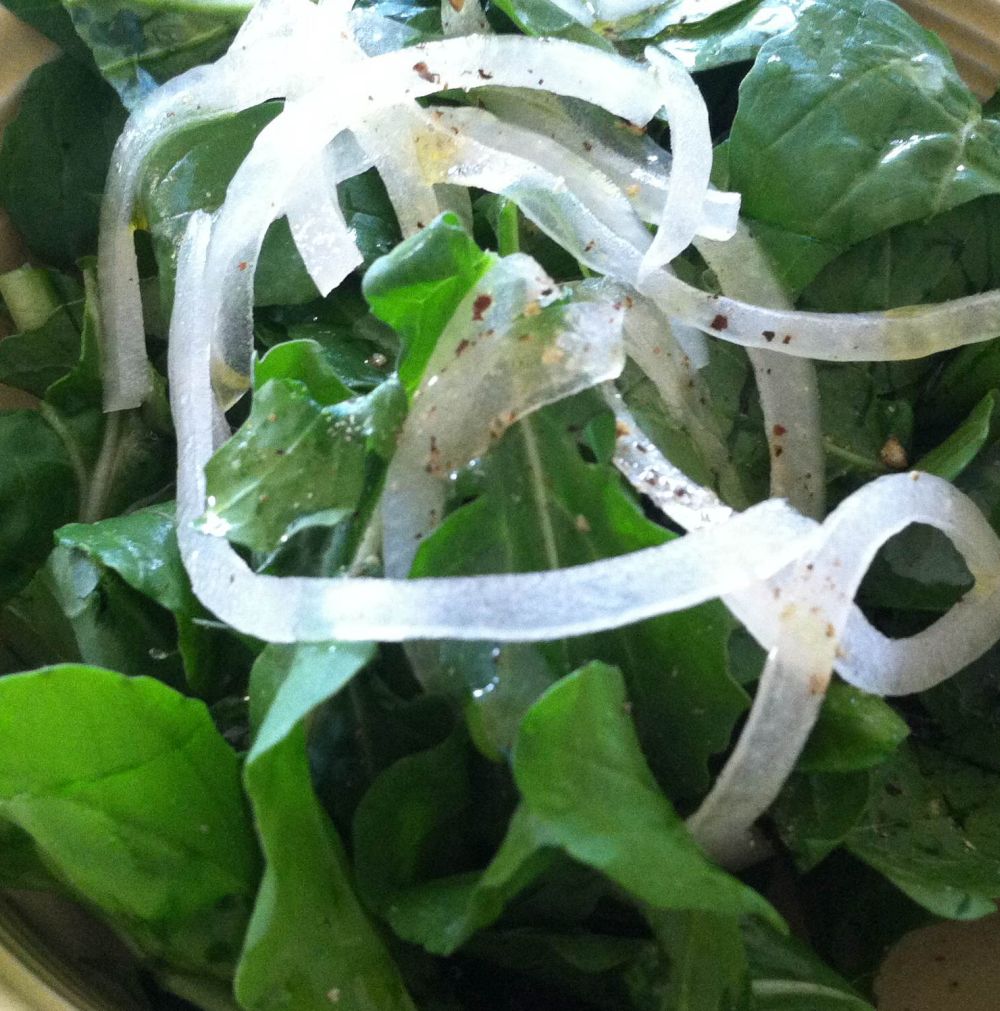
A simple salad of arugula {aka “rocket”} and thinly sliced onions, dressed with fresh lemon juice, extra virgin olive oil, freshly ground salt and pepper, goes well with fish crackers. It’s one of our favorite salads.
Arugula Salad with Onion and Lemon Juice & Extra Virgin Olive Oil
“Good soup is one of the prime ingredients of good living. For soup can do more to lift the spirits and stimulate the appetite than any other one dish.” Louis P. De Gouy, ‘The Soup Book’ (1949)
Have you noticed a change in the weather in your area? Maybe the mornings are a bit dewier than they were last month, and a sweater hits the spot in the evening. We have noticed that the mornings and evenings are a little cooler here on Maui, even though the days feel about the same, nice and warm. The first day of autumn is just around the corner {9/22}, which means it’s time to get out the soup pot. Our soup pot is never far from the stove. Even though we live on Maui, we eat a lot of soup, and surprisingly most of it hot soup, not cold. We live at about 1200 feet altitude, on the slopes of Haleakala Volcano, so it is often cool enough to enjoy soup, especially when the trade winds are blowing, as they are now. While it may feel warm outside in the sun, the breeze can feel cool in the house. We eat soup for breakfast, lunch and dinner. The soups we enjoy are all healthy; they are full of vegetables, high in vitamins and minerals and nutrient dense. I realize that people who live in places with 3 or 4 seasons probably don’t eat much hot soup in the summer, but like I said earlier, ready or not, autumn is on its way.
If you haven’t made home made soup, I encourage you to try out a few recipes; you will be rewarded with several delicious meals that don’t have to be complicated to prepare. There are some elaborate soup recipes out there, but the ones I make are pretty straightforward. I assure you that the soup you create from top notch fresh ingredients will be far superior to any soup you get from a can.
This minestrone is one of our new favorite soups, and I highly recommend it. This is the link to the original; what follows is my adaptation.
A bouquet garni made with 2 sprigs each thyme and parsley, a bay leaf, and a Parmesan rind
1 1/2 quarts water
1 tablespoon extra virgin olive oil
3 medium carrots, diced
3 celery stalks, diced
3 garlic cloves, minced {mince & let sit for 10 minutes for health benefits}
Salt, preferably kosher salt, to taste
1 28-ounce can chopped tomatoes, with liquid
Pinch of sugar
3 tablespoons tomato paste
About 1/2 small head of green cabbage, thinly sliced
1/4 cup chopped fresh parsley
Very thinly sliced celery, from the inner heart, for garnish
Freshly grated Parmesan cheese for serving
1. Combine the lentils, 1/2 onion and the bouquet garni with 1 quart water in a saucepan and bring to a boil. Reduce the heat, add salt to taste, cover and simmer 30 minutes.
2. Chop the remaining onion. Heat the olive oil in a large, heavy soup pot or Dutch oven over medium heat and add the onion, carrot, and celery. Cook, stirring often, until the onion is tender, about 5 minutes, and add the garlic and a pinch of salt. Stir together until fragrant, about 1 minute, and add the canned tomatoes with their liquid and the sugar. Bring to a simmer and cook, stirring often, for about 10 minutes, until the tomatoes have cooked down somewhat and smell fragrant.
3. Add the lentils with their broth, the tomato paste, salt to taste, an additional 2 cups water, and bring to a boil. Reduce the heat, cover, and simmer 30 minutes. During the last 10 minutes, add the cabbage. Taste and adjust seasonings. Season to taste with freshly ground pepper, stir in the parsley and serve, garnishing each bowl with thinly sliced celery heart if you want some crunch, and passing the Parmesan at the table.
Yield: Serves 4 to 6
Like most soup, this is even better the next day.
Nutritional information per serving (4 servings): 276 calories; 4 grams fat; 0 grams saturated fat; 1 gram polyunsaturated fat; 2 grams monounsaturated fat; 0 milligrams cholesterol; 49 grams carbohydrates; 12 grams dietary fiber; 392 milligrams sodium (does not include salt to taste); 17 grams protein
Nutritional information per serving (6 servings): 184 calories; 2 grams fat; 0 grams saturated fat; 0 grams polyunsaturated fat; 2 grams monounsaturated fat; 0 milligrams cholesterol; 32 grams carbohydrates; 8 grams dietary fiber; 261 milligrams sodium (does not include salt to taste); 11 grams protein
Notes:
* You may use any lentils that you like. I usually use brown lentils, but if you like your lentils to hold their shape, you may want to use the French green lentils {lentils du puy}.
* I highly recommend the celery & Parmesan garnish. Generally speaking, I find that if a recipe has a garnish, it’s best to put in the extra effort to put it on your soup. A garnish can take your soup to a higher level!
*Please, please, please do not use what they call “Parmesan cheese” that comes in the green can! Use the real thing; if you don’t use the real thing, you won’t have the Parmesan rind which adds a huge amount of flavor to your soup. It really does make a difference! Get more ideas on using Parmesan rinds to elevate your dishes to a whole other level here.
* If you do not have any kitchen twine, put it on your shopping list, and then you can tie your bouquet garni with a green onion top or chive {don’t tie too tight or they will break!}.
Are you one of the regulars at your local farmers market? If not, try to shop directly from your local farmers soon-you won’t be sorry. If you are, good for you!
Here are some scenes from the Upcountry Maui Farmers Market:
This slideshow requires JavaScript.
Tips for Shopping Your Farmers Market
The early bird catches the worm, so get there early ! ~ Some vendors sell items that are highly sought after {i.e. fresh fish, asparagus, etc}; they will sell out quickly. If you want something that is a hot seller, you had better get there early, or you just might be out of luck & have to settle for next best.
Bring cash, more than you think you will need {so you don’t need to worry about running out}, in small denominations ~ Vendors aren’t going to have the cash to make change if lots of people give them large bills. Try to have small bills/change as much as possible.
Be friendly!
~ Most of the folks you will encounter at the farmers market are looking for the same things you are looking for-high quality foods for reasonable prices. Just about anything is more fun with a smile.
Take plastic/cloth bags for your produce. ~ Many vendors do not provide bags. Find some big bags & reuse them. For example, Swiss chard does not fit in a gallon bag, so it is nice to have the larger bags. Big beautiful heads of lettuce need a big bag too, so they don’t get crunched up. You can put multiple things in each bag, and separate them when you get home.
You will need something in which to carry your purchases. ~ Some people use bags, while others have cool baskets to carry their market finds home.
Get to know your vendors; develop a relationship with the vendors you like to patronize.
~ When the vendor knows that you are a regular customer, you may get an extra eggplant, or they will select the best head of lettuce for you.
~ You may get a better price.
~ It’s fun to get to know the people who are working hard to provide you with the food you will eat that week.
~ If you see something you don’t recognize, ask your farmer how she likes to eat it. Give it a try, and then report back the following week.
Relax & have fun purchasing healthy foods to nourish your body!
“One of the very nicest things about life is the way we must regularly stop whatever it is we are doing and devote our attention to eating.” Luciano Pavarotti
“One of the very nicest things about life is the way we must regularly stop whatever it is we are doing and devote our attention to eating.” Luciano Pavarotti
“One of the very nicest things about life is the way we must regularly stop whatever it is we are doing and devote our attention to eating.” Luciano Pavarotti
“One of the very nicest things about life is the way we must regularly stop whatever it is we are doing and devote our attention to eating.” Luciano Pavarotti
“One of the very nicest things about life is the way we must regularly stop whatever it is we are doing and devote our attention to eating.” Luciano Pavarotti
“One of the very nicest things about life is the way we must regularly stop whatever it is we are doing and devote our attention to eating.” Luciano Pavarotti
“One of the very nicest things about life is the way we must regularly stop whatever it is we are doing and devote our attention to eating.” Luciano Pavarotti
“One of the very nicest things about life is the way we must regularly stop whatever it is we are doing and devote our attention to eating.” Luciano Pavarotti
“One of the very nicest things about life is the way we must regularly stop whatever it is we are doing and devote our attention to eating.” Luciano Pavarotti
“One of the very nicest things about life is the way we must regularly stop whatever it is we are doing and devote our attention to eating.” Luciano Pavarotti








 Maui Girl Cooks