Maui Girl Cooks

“One of the very nicest things about life is the way we must regularly stop whatever it is we are doing and devote our attention to eating.” Luciano Pavarotti


3 Comments

“How did it get so late so soon?”  Dr. Seuss

It’s a fact. . .I am behind.  I am behind in my blogging and I am behind in the online class I am taking {HarvardX: SPU27x Science & Cooking: From Haute Cuisine to Soft Matter Science}.  In addition, I am under the weather.  But it’s not being under the weather that has caused me to be behind; I have no good excuse for that, other than the fact that time gets away from me.  It always has, and I suspect it will continue that way into the foreseeable future {my husband certainly thinks so}.  I have not worn a watch since I stopped teaching in June of 2011, and I like it that way.  I love days when I could care less about what time it is, which are the 5 days a week that I do not go to work.  When I have something going on, I check the clock periodically, but other than that, I like just being present in the moment.

Since I am “lying low” around the house for a few days as I get well, I am going to try and do some catching up.  Yesterday, I finished up the lectures on the concept of elasticity {measured by determining how a food resists compression-think overcooked tough steak compared with rare tender steak}, which was the topic 2 weeks ago.  Today, I am hoping to start watching the lectures on diffusion and spherification, the topics from  last week.  Before next Tuesday, when the new lectures are posted, I need to view the lectures on this week’s topic of heat transfer.  Of course, I also have labs and homework to get done!  Where did the time go, and why did I let myself get behind?  This class is quite interesting, but the science is not for the faint at heart. Many moons have passed since I’ve thought about physics and chemistry concepts and equations; yikes!

I have a number of favorite ingredients, one of which is Parmesan cheese.  Like I mentioned in a previous post, I only consider fresh Parmesan that you grate yourself {Parmigiano Reggiano, Pecorino Romano, etc.}.  The stuff in the cylindrical green can just doesn’t cut it for me.

It doesn’t take long to grate up some fresh Parmesan and then pop it into a container to use on all kinds of foods.  You can use a hand grater, box grater or food processor.  It’s great on all kinds of salads, pasta, pizza, etc.

Grated Parmesan on Waxed Paper

Parmesan in Jar

Recently, we have gotten into Caesar salads, which of course include Parmesan cheese.  I have several Caesar dressings that I like, none of which come from a bottle.  One dressing, the one I’m going to share with you today, is from Alice Waters’ book The Art of Simple Food:  Notes, Lessons and Recipes from a Delicious Revolution.  The other recipe, which I haven’t made for quite awhile, I will share once I have made it again.  Of course, we enjoy Caesar salads with romaine, which is traditional, but Caesar dressing is also great on kale.  Without further adieu, because I have a lecture to watch on diffusion and spherification, here is one of my favorite recipes for Kale Caesar Salad.

kale caesar 1

Kale Caesar Salad

1 bunch kale, stemmed, well washed and dried
Caesar dressing
Croutons for garnish

Caesar Dressing {from The Art of Simple Food:  Notes, Lessons and Recipes from a Delicious Revolution

Mix together:
1 tbsp. red wine vinegar
1 tbsp. fresh lemon juice
2 garlic cloves, pounded to a puree
2 tsp chopped salt-packed anchovies {about 2-3 filets}
Salt
Freshly ground black pepper

Whisk in:
1/4 cup extra virgin olive oil

Right before serving, grate:
1/2 Parmesan cheese {about 1 ounce}

Whisk into the dressing:
1 egg yolk

Add a small handful of the grated cheese and whisk until thick.  Taste for salt and acid with a piece of kale.  Adjust the seasoning as needed.  Put the kale in a large bowl, pour three quarters of the dressing over the salad and toss.  Taste and add more if needed.  Add most of the rest of the grated cheese and toss lightly.  Arrange the salad on plates.  Garnish with the last of the cheese, croutons and a grind of pepper.  Serve with a wedge of fresh lemon.

Croutons {homemade croutons are immeasurably better than store bought}

Toss about 20 small bread cubes {about 1/2 inch square} with 1 1/2 tbsp. extra virgin olive oil and a little salt.  Spread on a baking sheet and toast in a 350 degree oven for 10-12 minutes, or until golden brown, stirring occasionally for even browning.

Notes:
*  I use anchovies packed in a jar, which I think would be less salty than the salt-packed ones.  I have never tried salt-packed anchovies.  I sometimes rinse sardines and then blot them dry to reduce their saltiness.
*  If you prefer not to use raw egg in your dressing, you could use a pasteurized egg.   I’ve used pasteurized eggs before with success.
*  Always use freshly squeezed lemon juice.  Avoid the bottled stuff, which is light years away from tasting like fresh.
*  For croutons, I always use whatever whole grain bread I have on hand.  May as well make the croutons as healthy as a crouton can be!

Bon appetit!

This is a link to Melissa Clark’s {food writer for the NY Times} take on anchovies:
http://www.melissaclark.net/blog/2011/04/anchovies.html


2 Comments

“The kitchen, reasonably enough, was the scene of my first gastronomic adventure. I was on all fours. I crawled into the vegetable bin, settled on a giant onion and ate it, skin and all. It must have marked me for life, for I have never ceased to love the hearty flavor of raw onions.”  James Beard (1903-1985)

First of all, I have to tell you that I am super excited about the class that I signed up for, which starts this Tuesday!  It’s called Science & Cooking:  from Haute Cuisine to Soft Matter Science.  It is offered through Harvard {yes, that Harvard!} and it’s free.  Scientists and chefs will be getting together to teach this course about the science of cooking.  Check it out!

This week’s farmers market find- freshly dug sweet Maui onions!  Yum!  We have been waiting for these & now they are here.

Group of Maui onions 1 Just about everyone has an opinion about onions.  We go through a lot of onions at our house, which is a good thing, because onions are a healthy food to eat, and they add great flavor to food. Group of Maui onions 3 We love all kinds of onions- green onions {aka scallions}, shallots, leeks, white onions, pearl onions, yellow onions and sweet onions {Maui, Walla Walla, Texas Sweets, Vidalia, etc.}.  They can be enjoyed raw, cooked or caramelized so that they are brown, sweet and jammy. Closeup of peeled  new Maui onion This onion was delicious in a salad with arugula, steamed beets and thinnings from the basil seeds I planted a few weeks ago {apologies to those who will not be growing basil outside for awhile!}.

Young Basil Seedlings 1

I hadn’t thought to pair basil with arugula, but it was a good match.  I consulted the Flavor Bible, which is one of my favorite books, and that is where I saw that basil and arugula go well together. Arugula salad with basil thinnings I dressed this salad with my usual arugula salad dressing of fresh lemon juice, extra virgin olive oil, freshly ground salt and pepper. Closeup of arugula salad with basil trimmings I have not always been an onion lover.  Like many kids, I ate my spaghetti with butter {I still love noodles with butter!}, salt and pepper.  I don’t remember if I had cheese on it, but if so, I’m sure it was that awful stuff in the green cylindrical can; you know the one to which I’m referring.  I think it was the onions in the spaghetti sauce to which my immature palate was objecting, but I’m not really sure why I didn’t want to eat spaghetti sauce.  I had no problem eating chili or beef stew, which definitely contained onions.  My mom’s {and now my recipe} delicious potato salad was eaten {by me} before the celery and onions went in.  It must have been the crunch, in addition to the onions, that I did not care for.  Crunch did not belong in creamy soft potato salad, in my opinion.  Mind you, I was not really a picky eater.  I ate just about everything, except celery, onions and this dressing that my grandmother made to dress dandelion greens.  It was some kind of cooked dressing, and I really did not like it.  In fact, I amazed my relatives with the quantities of food I consumed.  “Does she have a hollow leg?” they wondered.  “Where does she put it?” they inquired. Raw onions became a part of my diet in my early 20’s, when my husband returned from a business trip to Atlanta, GA with a sack of Vidalia onions.  He bought them at the airport, like tourists buy Maui pineapples at the Kahului Airport.  Boy, were those onions ever good; nice and sweet and perfect mingling in a bowl with sliced cucumbers, extra virgin olive oil, salt and pepper.  My mom makes great cucumbers and onions with apple cider vinegar, salt and pepper; I’m sure I just ate the cucumbers way back when.  Now, I can’t get enough onions.  Thankfully, most kids grow up and expand their food horizons to include foods they wouldn’t touch in their youth, but now find delicious. Several techniques can be employed to make onions more palatable, as well as make them more suitable for a particular dish.  The way an onion is cut makes a huge difference on how it tastes in any given recipe.  Click here to view a Fine Cooking video on a few different onion cutting techniques. I usually cut onions 4 different ways: Large Dice– Large dice is great for onions that will be cooked in spaghetti sauce, stew, vegetable soups, this quesadilla filling and that type of thing.  The large dice holds its shape during cooking, but at the end will be soft and pleasant to eat. large dice onion Minced- Minced onions belong in guacamole, potato salad, coleslaw, some bean salads and places where you don’t want to bite into a big piece of raw onion, especially when that onion isn’t a sweet variety. Minced onions Lyonnaise– Lyonnaise is also called “pole to pole” because you are cutting the onion in crescent shapes from the root end to the blossom end.  It is my favorite way to cut onions!  I love this cut for green salads, cucumbers and onions, pickled beets and recipes where I want to see the onion, and taste it, but not have big chunks.  When I cut this way, I always thinly slice the onions if they are to be served raw.  Even a strong onion {i.e. not a sweet variety} is palatable when thinly cut pole to pole. Lyonnaise cut onions 3 Sliced- Sliced onions are cut across the equator, and are great served raw or caramelized on a burger, sub {hoagie, grinder, etc.} or other sandwich.  I think onions for sandwiches should always be sliced paper thin; pile them on, but they must be thin or they will slide right off {Tomatoes too should be thinly sliced, but my mom will disagree with me here.} Sliced red onions If you are tired of your green onion slices rolling off the cutting board, try slitting the white part of the onion lengthwise, so you have half-moon slices-no more mischievous onion slices rolling around!

Not just a tasty vegetable and seasoning for many foods, onions have numerous health benefits.  Click on this link to the National Onion Association for nutritional information, tips and recipes.

This is  how one amongst us spent his day. . . not an ounce of friskiness in this pussycat! Jack napping

How do you enjoy onions?

Bon appetit!


4 Comments

A Favorite Lunch

Did you know. . .
. . . that sardines packed in their own oil or extra virgin olive oil are full of good for you omega-3 fats?  It is thought that just 1/2 gram of these fats can significantly reduce your risk of cardiovascular disease.  Avoid sardines packed in vegetable oils, as they are not healthy fats.

Anyone for anchovies?  How about sardines?  I know, I know, these are a couple fish that cause many people to turn up their noses.  Not me though; I love them both.  My intention was to write only about sardines, but I figured as long as we are on the subject of unpopular fishes, I may as well tell you how we like to eat anchovies.  Perhaps our way of eating anchovies will work for you as well, that is, if you want to give them a try.

Once upon a time, I too was among the myriad of folks who did not care for anchovies, as was my husband.  One rainy evening, we were eating pizza at Tony’s Pizza & Italian Restaurant, a favorite Italian restaurant of ours in Bremerton, WA.  That is the night we learned how to eat anchovies.  The secret to liking/loving anchovies on your pizza, according to our waitress, is to order them on the side.  Wow, that really makes a difference!  The salty, fishy flavor permeates the pizza if you bake the anchovies on the pizza, but if you have a little plate of anchovies on the side, it tastes pretty good.  You get an occasional salty punch from the little bits of anchovy.  We have happily eaten anchovies on our pizza ever since!

I have been eating sardines for as long as I can remember.  We had tins of sardines in our pantry when I was growing up, and I admit that even though I ate them, I thought they looked kind of gross.  My recollection is that they were not like the nice sardine filets that we eat now, which are every bit as nice looking as a beautiful piece of fresh salmon {except they aren’t pretty pink}.

Wild Planet Sardines

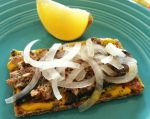
One of my favorite quick lunches is a “fish cracker” and a salad.  And no, by “fish cracker,” I am not referring to those fishy-shaped crackers that you are probably familiar with. . .the ones with no redeeming nutritional value.  My idea of a “fish cracker” is a Ryvita cracker with a plump, meaty and delicious sardine on top.  Of course, there are additional toppings to make it extra tasty.  This is a favorite lunch of mine because it is quick, tasty and super healthy.

This slideshow requires JavaScript.

I understand if you don’t like anchovies, and don’t want to give them a second {first} chance.  But if you like fish, and haven’t gotten into sardines, I highly recommend them.  The health benefits of sardines {& anchovies} are many:

  • They are low on the marine food chain, so toxins like mercury do not accumulate in them.
  • Anchovies and sardines are chock full of healthy omega-3 fats, which impact mood, circulation, glucose, insulin metabolism, blood pressure and heart health.
  • In particular, sardines are high in protein, B vitamins, selenium, calcium, iron, magnesium, phosphorus, potassium, zinc, copper and manganese.  Talk about a powerhouse of nutrition in one little can!  They are my idea of a great “fast food!”

Sources:

The 150 Healthiest Foods on Earth, Jonny Bowden, Ph.D., C.N.S.

The Perricone Promise, Nicholas Perricone, M.D.

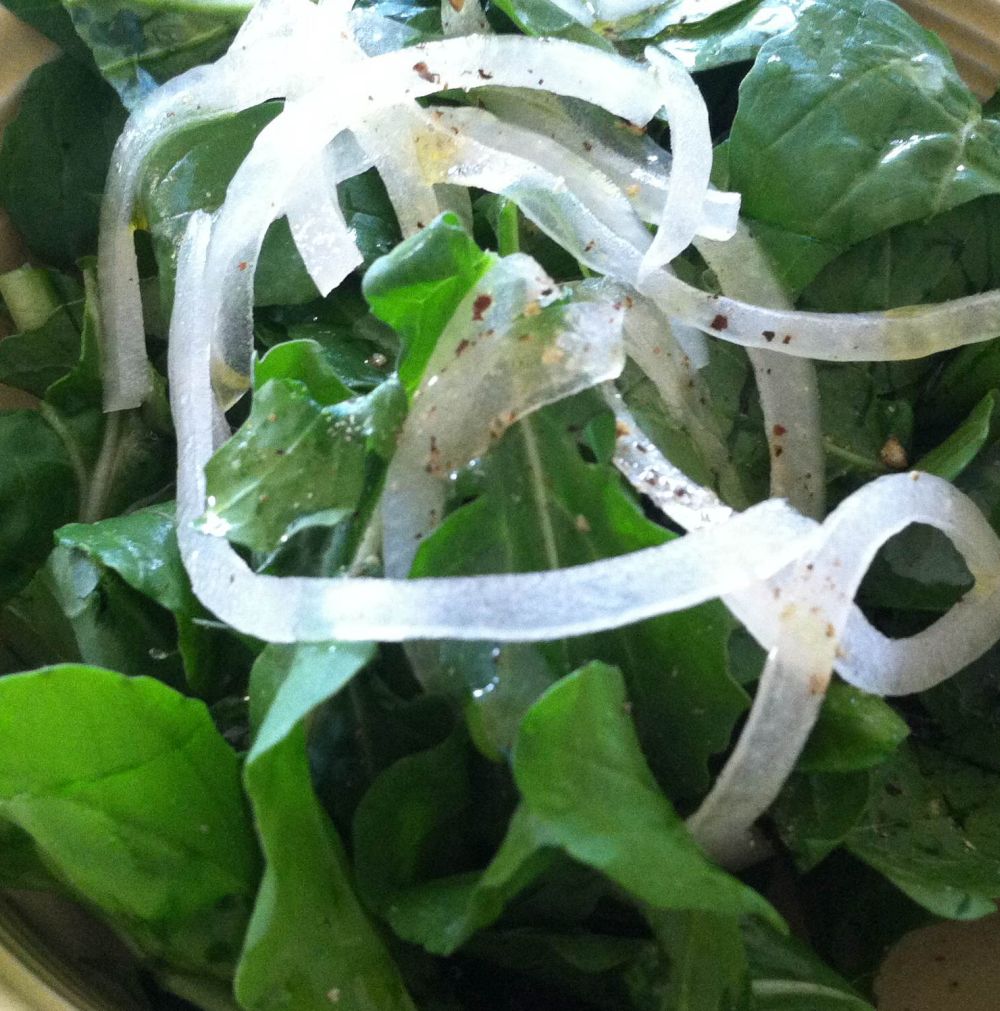
A simple salad of arugula {aka “rocket”} and thinly sliced onions, dressed with fresh lemon juice, extra virgin olive oil, freshly ground salt and pepper, goes well with fish crackers.  It’s one of our favorite salads.

Arugula Salad with Onion and Lemon Vinaigrette

Arugula Salad with Onion and Lemon Juice & Extra Virgin Olive Oil


1 Comment

“The old Romans having expelled physicians out of their commonwealth, did for many years maintain their health by the use of cabbages, taking them for every disease.”  16th century historian

Welcome to my 3  5 9 day post.  Yep, it took 9 days for me to get this written and posted.  Why??  I have no idea!!  No good reason though, that’s for sure.

I worked late last night {Monday}, so took the opportunity to sleep in a little later than usual, which was nice.  It was a breezy “2 blanket night,” the first one for quite a while.  This morning has been one of those putz around the house mornings where I suddenly realized that my walk would have been significantly cooler had I left earlier.  Podcast selected, I popped in my ear buds, put on my hat, sunglasses and shoes, ready to go.  Open door. . .it’s raining!  You might wonder how I could not have known that.  Weather-wise, we live in a very interesting place.  Dark gray clouds may gloomily loom out one window, with a gleaming blue sky out another window, just 20 feet away.  So often, the gray clouds that hang around our house do not drop rain; I would certainly like a bit more rain, as would our plants.  Funny thing to say, from someone who lived in the Pacific Northwest for over 20 years!  The clouds are splashing rain this morning, and I am enjoying every minute of it.

I’ve had half a cup of green tea, and now it looks like a good time to walk.  Be back soon.

I’m back!  More sprinkles soon after I returned, so I guess my timing was pretty good.  Actually, my walk was timed perfectly, as was my choice of routes.  I found a fallen Meyer lemon {I LOVE Meyer lemons!}, which is a cross between a regular lemon and a Mandarin orange.  Meyer lemons have not been available in the United States until fairly recently, and may not be found everywhere.  If you are a lemon lover, and you see Meyer lemons, buy some; they are so delicious.  I come from a long line of lemon eaters, and I can tell you that my mouth is watering right now.  I love lemons sprinkled with salt-so good {not great for the enamel on your teeth, but so tasty}.  Meyer lemons have a floral quality to them, in their flavor and their aroma.  They are thin-skinned, so you can eat the entire lemon.

Meyer lemon wedgeClick here to read a short article/hear a short interview about Meyer Lemons.  I also found a pommelo.  The owner of the pommelo tree told me a few weeks ago that I could pick what I could reach; score!.  I was thrilled to find one that had blown off in the wind, to my good fortune.  Pommelos are similar to grapefruit, but their fruit is not as soft as a grapefruit, and the flavor is a little different.

This slideshow requires JavaScript.

To be continued, tomorrow!

Wednesday- No fallen fruit today, nor rain, just a beautiful blue sky & gentle breeze to keep us nice and cool.

Let’s talk about cabbage.  I love cabbage!  By all accounts, my mom makes fantastic coleslaw.  Even though I like all of the ingredients in her coleslaw, I never cared for it as a kid.  She always gave me a bowl of cabbage with nothing on it, before she mixed in the dressing.  My dad loved her coleslaw because it doesn’t have a sweet dressing.  Here is her recipe.

Mom’s Coleslaw

4 cups finely shredded cabbage
1/2 cup mayonnaise
2 tbsp lemon juice
2 tbsp grated onion
Salt and pepper to taste
Celery seed to taste {my mom says that it is important to use celery seed for best flavor}

My mom always grates her cabbage in a blender, with water, which makes a very fine shred; she said that her mom liked it that way.  After processing in the blender she drains the cabbage well, so the dressing will not be watery.  You can shred your cabbage however you prefer.  Mix the remaining ingredients and mix with the cabbage.  Chill until ready to serve.

My preferred way of eating cabbage has always been cooked, as in corned beef and cabbage, minestrone soup, borscht, etc.  And then I discovered roasted cabbage.  OMG!  Roasting cabbage gives it a depth of flavor that raw cabbage cannot ever hope to achieve.  It is quite delicious, and I have to restrain myself from eating the entire head of cabbage after it emerges from the oven, roasty-toasty brown with soft centers and crispy edges.  Sprinkled with fresh lemon juice, roasted cabbage is delectable and just waiting to be eaten, leaf by leaf, standing up by the stove, where you have put it to cool.  If you manage to have any leftovers, I also find it delicious cold or at room temperature.

Roasted Cabbage with Olive Oil & Lemon
recipe adapted ever so slightly from eat.repeat

1 head of green cabbage
Extra virgin olive oil
Salt & pepper
Freshly squeezed lemon juice

Pull off the large outer cabbage leaves.   Wash the head of cabbage and dry well.  Cut the cabbage in half, and then cut the halves into fourths, leaving you with 8 wedges.  Try to keep a bit of the core on each wedge, so that the wedges have a better chance of staying together.  Put your cabbage wedges on a sheet pan lined with foil.  I like to line my sheet pan with foil to make clean up a little easier.  Brush the cabbage with olive oil and sprinkle with freshly ground salt and pepper.  Roast in a 400 degree oven for 30-40 minutes, flipping the wedges about halfway through.  Roast until the cabbage is browned, even to the point of the edges being crispy brown {much tastier this way!}.   Sprinkle cabbage with lemon juice & eat hot, warm, room temperature or cold.  Yum!

This slideshow requires JavaScript.

Bon appetit!


1 Comment

Salad with Purslane & Ribbons of Parmesan

“When weeding, the best way to make sure you are removing a weed and not a valuable plant is to pull on it.  If it comes out of the ground easily, it is a valuable plant.”  Author Unknown

I do not know if purslane comes out of the ground easily or not, but I have seen it defined both as a weed and a valuable plant.  Purslane is purported to be a healthy plant that we should be enjoying.  It is a good source of omega-3 fatty acids, antioxidants, vitamins and minerals.  Check out the articles at the end of this post if you would like to read more about purslane’s health benefits.  My husband bought our first bunch of purslane 2 weeks ago, at the Upcountry Farmers Market.  It’s great!  What I like most about purslane is its chew, due to the fact that it is a succulent.  I think it has a subtle flavor, not at all assertive, but just tasty. . .green.  Apparently it grows everywhere, but I can’t say I’ve encountered any on my walks around Pukalani, where we live.  You will most likely not find purslane at your local grocery store, but look for it at your farmers market.  Or grow it yourself; from what I’ve read, it is easy to grow.

When I cleaned the first bunch of purslane, I meticulously removed the leaves from the stems.  I discovered on the second bunch that “de-leafing” {is that a word??} the stems is not necessary, and that the stems also add a bit of chew to a salad.  The leaves are in clusters on the stems, so that makes them pretty in a salad.

Salad with Purslane & Ribbons of Parmesan

This is not a tossed salad, but more of a composed salad, which I think is prettiest served on a plate. The ingredients are few and the salad is delicious.  When you start with excellent ingredients, you do not need much to create great food.

Place a layer of tender lettuce on a plate.  Some good choices are Bibb, Manoa or red leaf.  A crunchy lettuce like romaine doesn’t work in this salad.  Texture is important in this recipe; there is a pleasant “chew” but it isn’t a crunchy salad.

Top the lettuce with some onion that you have sliced paper thin.  Use whatever type of onion you prefer, although I wouldn’t choose green onions for this.  Slicing the onion super thin makes it seem less pungent, making it easier to eat for the “non-onion types.”

Now add a scattering of paper thin purple cabbage.

Top with purslane, preferably in clusters of leaves, as opposed to individual leaves; this adds to the salad’s texture.

Sprinkle the salad with some pumpkin seeds that you have pan roasted, preferably in coconut oil.

Season the salad with freshly ground salt and pepper, then sprinkle with fresh lemon juice {about 1/4 of a juicy lemon per salad} and a drizzle of good extra virgin olive oil.  Use a light hand with the dressing, as you don’t want your salad to be swimming in dressing.

Finally, take a vegetable peeler and shave some nice ribbons of fresh parmesan cheese over the salad.

Salad with Purslane and Ribbons of Parmesan

Related articles

Bon appetit!


2 Comments

“The secret of good cooking is, first, having a love of it… If you’re convinced that cooking is drudgery, you’re never going to be good at it, and you might as well warm up something frozen.”  James Beard

Hummus

If you think you don’t like hummus, perhaps you have only had store bought varieties, too stiff and poorly seasoned.  I must admit, I haven’t tasted much packaged hummus; there probably are some good ones, however, I  prefer to make my own hummus from freshly cooked garbanzo beans.  Of course, you can use canned beans, but I have found them to be a little more al dente than I like.  They are best when they are nice and soft, ready for a whirl in the food processor with garlic, olive oil, lemon, tahini and seasonings. The beans take awhile to cook, but it isn’t hands-on time, so you can be doing whatever you like while they simmer away on the stove. For me, cooking a pot of beans is kind of therapeutic, like making risotto, kneading bread or watering plants.  Homemade hummus isn’t difficult to prepare and the results are worth any effort required. People are favorably impressed if you show up at a potluck with a gorgeous platter of hummus with tasty garnishes {especially if you make homemade pita bread!}.  As promised in my last post, here is my hummus recipe.

Hummus 

1 ½ c cooked garbanzo beans {I always cook my own, because they are much better, but you can use canned.}
3 cloves garlic, minced
Scant ¼ c tahini
2 tbsp extra virgin olive oil {I use quite a bit more, for a smooth & silky texture.}
Juice of 1 lemon
1 tsp kosher salt

 Puree all ingredients in the blender or food processor until really smooth.  I like to spread it out on a platter and drizzle extra virgin olive oil over it.  Sprinkle with chopped tomatoes, kalamata olives and cilantro {any or all are good}.  Eat with pita bread, or whole wheat flour tortillas that you brush with olive oil, cut into eights and then bake at 350 until semi-crisp.  Also good with fresh fennel Fennel Bulb or sliced cucumbers.


Freshly Cooked Garbanzo Beans

1 cup garbanzo beans, cleaned & soaked {you don’t have to soak them, but they will take longer to cook}
Aromatics: 1 onion, quartered, 2 parsley sprigs, 4 garlic cloves
1 tbsp extra virgin olive oil
6” piece of kombu, or a few pinches asafetida, optional {I love to eat the cooked kombu}
1 ½ tsp salt

Cover garbanzo beans with 2 quarts fresh water & add remaining ingredients.  Simmer until completely tender, but not mushy.  I start checking at around 45”.  Let the beans cool in the broth.

Wilted Dandelion & Arugula with Walnuts & Beets

We enjoyed the plate of hummus with homemade pita bread and this salad of Wilted Dandelion Greens & Arugula with Walnuts & Beets.  Dandelion greens and arugula are supposed to very good for you, so we are eating them regularly.  They are kind of bitter, which is what makes them good for you.  When you eat them with something sweet like beets, it somewhat neutralizes the bitterness, and they are quite tasty prepared this way.  This recipe is adapted from Deborah Madison’s excellent cookbook Vegetarian Cooking for Everyone {I love this book!}

Wilted Dandelion Greens & Arugula with Walnuts & Beets

Dandelion greens and/or arugula, about 1/2 pound
1 large garlic clove, mashed into a paste with 1/4 tsp kosher salt
1 large shallot, minced
4 tsp sherry vinegar or aged red wine vinegar
5 tbsp extra virgin olive oil
Freshly ground pepper

Whisk together the garlic paste, shallot, vinegar & olive oil.  Heat the vinaigrette in a small skillet until it sizzles.  Pour over the greens & toss with plenty of freshly ground pepper.  Top with toasted walnuts, cooked beets & a grating of Gruyere or Jarlsberg cheese.  It’s delicious with just the cheese, but the walnuts & beets add a bit of crunch & sweetness.

The first time I made this, we were too full to eat it all at dinner.  I put the leftovers in the refrigerator, not knowing how delicious they would be cold the next day.  I think I probably like them leftover as much, if not more, than freshly made.  Who would have thought?

Aloha & Happy Cooking!